Exhibitions
Writ in Water
Devening Projects, Chicago, IL
March 20 - May 10, 2025
Press Release
Devening Projects is pleased to present Stacy Jo Scott’s first solo exhibition at the gallery and first in Chicago. Writ in Water features a ceramics project that utilizes advanced systems to bring ancient production together with digital technology. Writ in Water opens on Sunday, March 30 and continues until May 10, 2025.
In her statement for the exhibition, Stacy Jo says “These works are drawings etched into dry clay or dragged through wet colored slip using a CNC router and stylus. The underlying framework for the drawings emerges from programming scripts based on descriptions of imperial Roman architecture, which were developed with AI-generated code. I alter, layer, overlap, and amend these simplified interpretations to create imagery that seems at once ancient and speculative, evoking a future yet to come.
While digital processes operate in a seemingly timeless realm of perfect repeatability, clay connects to geological time—formed over millennia and bearing the capacity to endure long after our digital systems have become obsolete. “Writ in water”—this phrase, etched into Keats’s grave marker, captures the central tension in these works.
There’s an intentional irony in using AI to interpret symbols of imperial power, while that same technology increasingly functions as a form of concentrated authority in our digital lives. The clay tablets physically manifest this contradiction: they preserve AI’s idealized forms while simultaneously transforming them through material processes beyond algorithmic control. Just as ancient empires left behind ruins despite their claims to eternal authority, these tablets suggest that our contemporary systems of technological power—despite their apparent invincibility and efficiency—remain subject to realities they cannot transcend.
As the bit follows its programmed path, the clay responds with its own material resistance—crumbling and chipping along the precise lines. Though newly created, the etched forms immediately appear weathered, as if excavated from an archaeological site. This visual transformation creates objects that exist in multiple temporal states—brand new yet ancient-looking—embodying both the precision of technological control and the inevitable processes of erosion that await even our most sophisticated systems.”


Otherworld/s
Schneider Museum of Art, Ashland, OR
January 16 - March 15, 2025
Group Exhibition with Heather Lee Birdsong, Ben Buswell, and Alex Ito
Photographs: Ezra Marcos, and Mario Gallucci
Press Release
"Much of what we know today about ancient Roman life comes from the ruins of Pompeii after the eruption of Mount Vesuvius in 79 AD. Major archeological digs of the site didn’t begin until the mid-18th century, and although there were many things lost to looting and decay, there was a surprising amount of artifacts retrieved from the ash. One of these artifacts was a sculpture known today as “Satyr and Hermaphrodite”, a marble statue depicting a satyr and Hermaphrodite, an intersex child of Hermes and Aphrodite, in the middle of an altercation. Satyrs represented the animalistic side of human nature. Coupled with the fact that they were often used as symbols of sexuality and aggression, it is assumed that this is a scene of Hermaphrodite fighting off assault. Artist Stacy Jo Scott was inspired by this work, citing it as a moment of recognition. As a Queer person, she found herself empathizing with Hermaphrodite and was inspired by their fight against the violence imposed onto them. Scott honors this relationship with Hermaphrodite in their series of the same title, depicting struggling and disjointed body parts and freedom in the form of kaleidoscopic, abstract forms."


Echo & Narcissus
AB Projects, Los Angeles
Performance, June 30, 2023
“In the myth of Echo and Narcissus one sees the myth as about the relationship between specular image and voice, between sight and voice, between light and speech, between the reflection and the mirror.“ - Jacques Derrida
Translation is not a mimic, or a mirror, but an echo.
I stand in the gallery between Echo and Narcissus, icons of a meeting between bodies. Digital scans of the original stone sculptures are translated into sound by a program that turns their periphery into musical notes. The notes are generated in relation to the shape of the surface, creating a cipher for reproducing the form through sound.
Using these notes as a guide, I plot a circular matrix and transcribe them into three-dimensions. As this process unfolds, clay coils stack and shapes form line by line. The original objects become new figures. I listen to their sound, like Echo, and animate them from this sound. Like Narcissus, I merge object and reflection.


Poetics of Landness, Poéticas de las Tierras,
Landaktig Poesi
Galleri ROM, Oslo, Norway and Carnation Contemporary, Portland, OR
Collaboration with Arely Amaut Gomez Sanchez, Sigrid Espelien
January 25 - January 29, 2022
Press Release
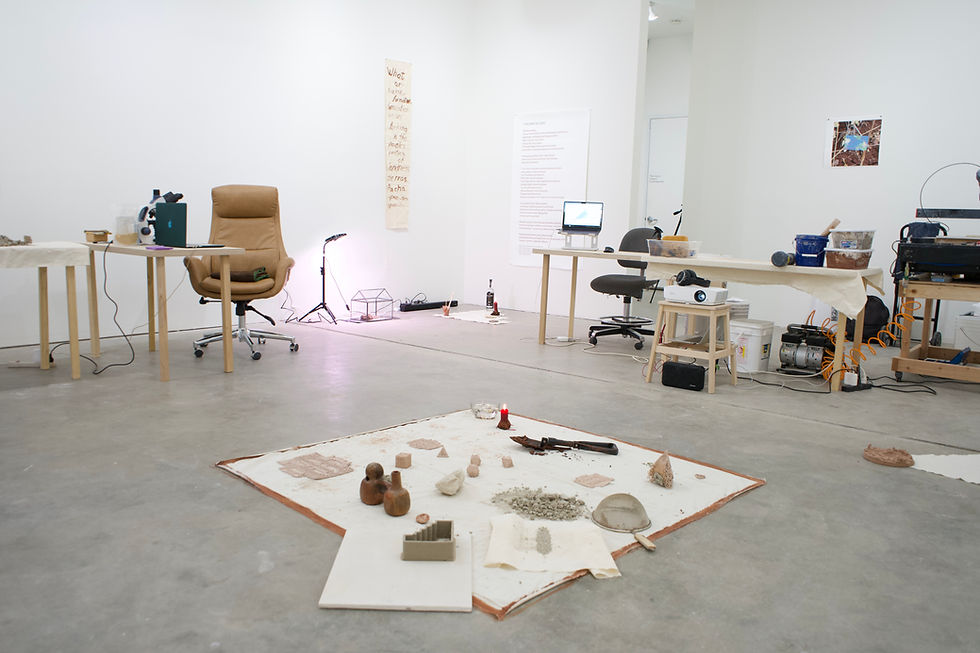
Poetics of Landness, Poéticas de las Tierras, Landaktig Poesi is a working exhibition and international collaboration between Arely Amaut Gomez Sanchez (Lima, Peru), Sigrid Espelien (Oslo, Norway), and Stacy Jo Scott (Oregon, USA). A concurrent exhibition will run at Galleri ROM in Oslo, Norway, and the overlapping activities of each exhibition will be simultaneously shared and broadcast between Galleri ROM and Carnation Contemporary.
Based on an ongoing collaboration between Amaut, Espelien, and Scott, we invite the public to visit Carnation Contemporary throughout the week to witness processes dealing with landness, and experiences of the underground. This exhibition includes video, clay from the places where the three are located, translations through digital fabrication such as 3D scans and 3D printing with clay, audio trance processes, and experimental installations.
Landness is about land in action, in becoming, and is not singular or objective. It contains a multiplicity of beings which are part of this becoming - both seen and unseen, sentient and non-sentient. Together we think through ways that unearthing/gathering clay can be “non-extractive”. What does it mean to gather but not to take? How does one land differ from another? Is it only the minerals contained in it? Why would one land/clay be better than another? What does this have to do with the classification given by social power structures?
We consider the ways in which earth, soil, and mud are ancestral beings that bring critical venues for exploration that might help us to listen, remember, and embody. Together we consider the potential of land and creative practice to disrupt the very basis of modern representation and ongoing colonial systematic violence.


Lo, A Vase in the Dark
Holding Contemporary, Portland, OR
June 11 - July 24, 2021
Photographs: Mario Gallucci
Press Release
In Lo, A Vase in the Dark, Stacy Jo Scott translates fragments of 3D scans and code-based processes into clay figures, masks, and vessels. Scott parses out digital shards, partial stories, and fragmentary objects and reconstructs them as new bodies, forming new lineages. The collaged works included in the exhibition are formed through the artist's process of imagining a new body woven from the past. Rescanned and reformed through the use of digital processes with clay, the body enters a space of machinic order and is rendered malleable, changeable, inexact, and hollow. Full of holes, gapes, and wounds, the body is represented as sliced and incomplete. Scott’s sculptures and prints portray human physicality as raw material to bend, twist, and reform into new creatures and reimagined bodies through spectral association.
Stacy Jo Scott uses ceramic objects and digital processes as anchors from which to navigate shifting landscapes of queerness, embodiment, and spectrality. These objects emerge from research, digital processes, trance practices, and chance operations. Her work revolves around imaging the ephemeral body and speculating on queer lineages and futurities. The speculative nature of her inquiries is grounded in confounding the relationship between clay’s materiality and the supposed purity of machinic code. Stacy Jo explores how digital media renders embodiment, and how computational tools can be used to convey illegible histories or mythic futures. She employs the more ancient skills of hand-working clay alongside generative software tools, unorthodox 3D printing, and CNC hacks. The idiosyncrasies of clay interrupt the numeric logic of the machine, looping it back into a queered transient world of direct embodied experience.


The Sign of the Enterer
Truckenbroad Gallery, Corvallis, OR
April 18 - May 6, 2019
Photographs: Bill Holderfield
Press Release
The Sign of the Enterer consists of a series of objects and performances that are based on a text written using a early artificial intelligence predictive keyboard program. Stacy Jo Scott built the objects for The Sign of the Enterer by following the object descriptions generated by this algorithmic text. These instructions, which were born from a human–machine collaboration, became filtered and re-translated through the clay, as well as the artist's haptic toolset and idiosyncrasies.
The objects stand as markers of this process and reveal how a poetics of computation can emerge through the imprecision and subjectivity of human-machine collaborations and clay. Such thinking unsettles the commonly evoked body-machine dichotomy, honoring the multiplicity of human experiences and our entanglements with machinic technologies.
Such multiplicity reflects a queerness that rests, sometimes hidden, within contemporary
experience. Queerness, which is ever shifting and evades definition, attaches a name to the experiences that occur within the liminal spaces between what have been incorrectly assumed to be clearly defined, immutable categories and identities.


%20copy.jpg)